Sorry... Cosmix was built as a web design demo site.
You can view the Home page, Blog Page, and/or read blog posts.
The About, Contact, and Learn More links are just filler content.

Sorry... Cosmix was built as a web design demo site.
You can view the Home page, Blog Page, and/or read blog posts.
The About, Contact, and Learn More links are just filler content.



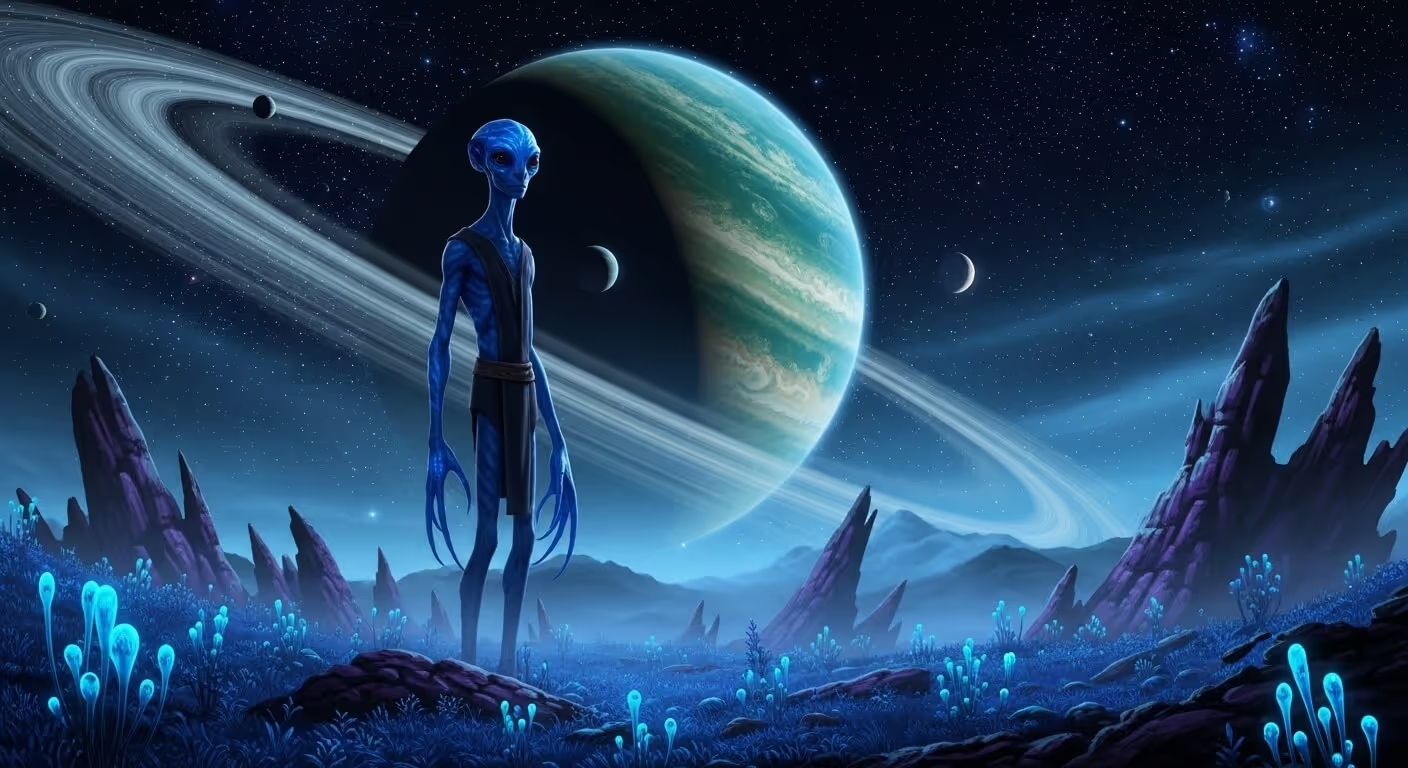
For millennia, humanity has looked up at the stars and pondered one of the most profound questions imaginable: Are we alone in the universe?
This isn't just a scientific query; it's a philosophical one that touches upon our understanding of life, consciousness, and our unique place in the cosmos.
Today, thanks to incredible advancements in astronomy, biology, and technology, the search for extraterrestrial life has moved from the realm of science fiction to a vibrant and active field of scientific inquiry.
Our understanding of where life could exist has expanded dramatically with the discovery of thousands of exoplanets – planets orbiting stars other than our Sun.
Crucially, many of these exoplanets reside in what scientists call the "habitable zone," or Goldilocks Zone. This is the region around a star where conditions are "just right" for liquid water to exist on a planet's surface.
And on Earth, where there's liquid water, there's life!
While finding a planet in the habitable zone is exciting, it's just the first step. Scientists are also looking for other indicators, such as:
The James Webb Space Telescope (JWST) is revolutionizing this search, capable of analyzing the atmospheres of distant exoplanets with unprecedented detail, potentially sniffing out the chemical fingerprints of life.
We don't even have to leave our own solar system to find intriguing possibilities for life. While Mars remains a prime candidate, with evidence of past liquid water and ongoing searches for subsurface microbial life, some of the most exciting prospects lie in unexpected places: the icy moons of Jupiter and Saturn.
Beyond the search for microbial life, the SETI (Search for Extraterrestrial Intelligence) program continues its efforts to detect signals from advanced civilizations.
Radio telescopes around the world scan the cosmos, listening for artificial patterns or transmissions that would stand out from natural cosmic noise.
While we haven't yet received a clear "hello," the absence of a signal so far doesn't mean no one is out there; it just means we haven't listened long enough or in the right way.
The sheer size and age of the universe suggest that life, and even intelligent life, should be common. This leads to the Fermi Paradox: If extraterrestrial life is so probable, where is everybody?
Why haven't we found any definitive evidence yet?
Possible explanations range from:
The quest to answer "Are we alone?" is one of humanity's most ambitious endeavors. It challenges us to expand our definitions of life, push the boundaries of technology, and confront our place in a universe that is both vast and profoundly mysterious.
While the answer remains elusive, every new discovery brings us closer to understanding the incredible potential for life beyond our home planet.

