Sorry... Cosmix was built as a web design demo site.
You can view the Home page, Blog Page, and/or read blog posts.
The About, Contact, and Learn More links are just filler content.

Sorry... Cosmix was built as a web design demo site.
You can view the Home page, Blog Page, and/or read blog posts.
The About, Contact, and Learn More links are just filler content.



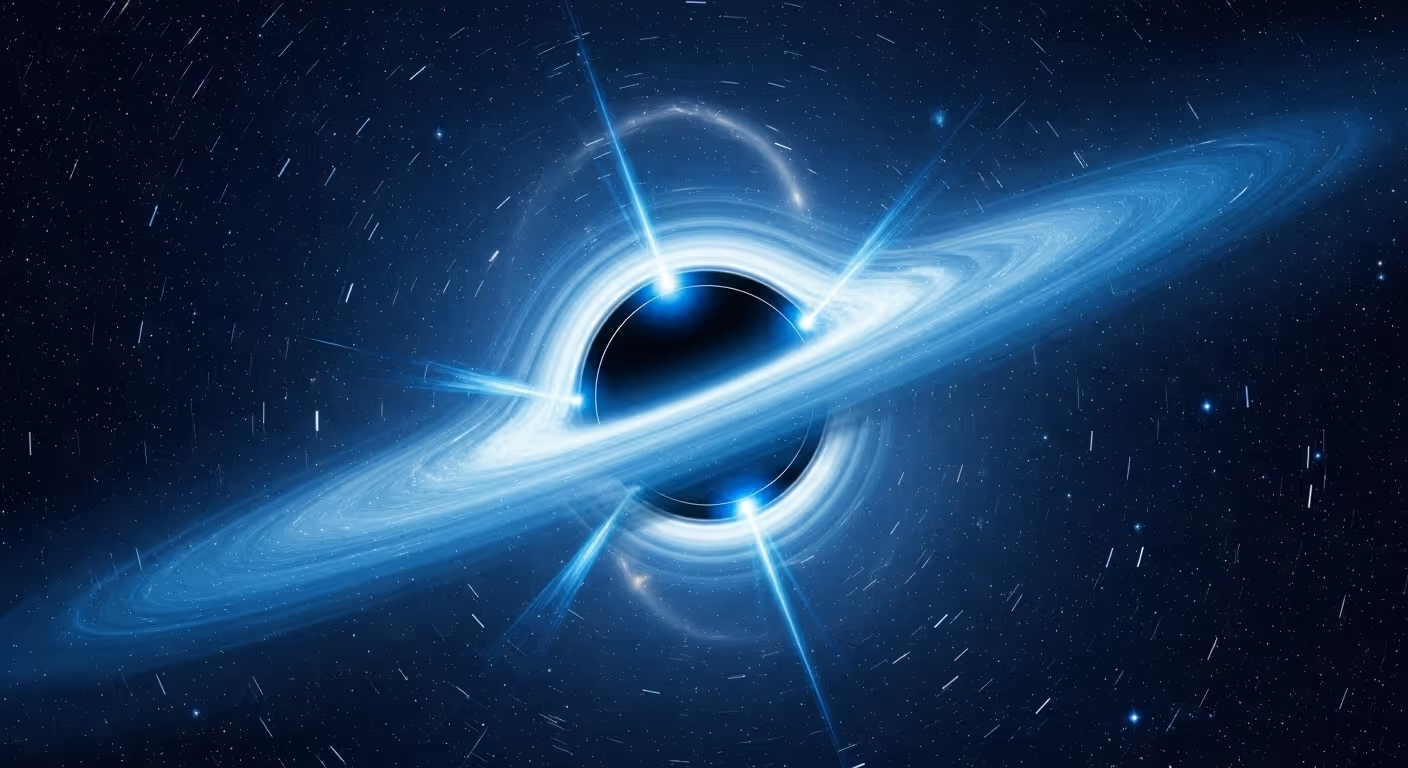
When you hear "black hole," what comes to mind? Likely an image of a terrifying cosmic vacuum cleaner, mercilessly devouring anything that dares to stray too close, a point of no return where even light itself cannot escape.
While these aspects are undeniably true, the narrative surrounding black holes is far more nuanced and fascinating.
Far from being mere destructive monsters, these enigmatic singularities are increasingly understood to be crucial galactic architects, playing a surprisingly vital role in the formation and evolution of the universe's grandest structures.
Let's first acknowledge the "monster" aspect. A black hole is born from the collapse of a massive star, or through the accumulation of vast amounts of matter at the center of a galaxy.
Its defining characteristic is its immense gravitational pull, so strong that it creates a region of spacetime known as the event horizon. Cross this boundary, and you are irrevocably doomed to spiral towards the singularity – a point of infinite density at the black hole's core.We categorize black holes primarily by mass:
Now, for the "architect" side of the story. For decades, scientists puzzled over the strong correlation between the mass of a supermassive black hole and the total mass of its host galaxy's bulge (the central, spheroidal component).
This suggested an intimate connection, far beyond mere coincidence. How could a relatively tiny black hole, even one supermassive, influence millions or billions of stars across thousands of light-years? The answer lies in their dramatic, yet ultimately constructive, feedback mechanisms.
Even our Milky Way's supermassive black hole, Sagittarius A* (Sgr A*), though currently quiescent, has likely played its part. Evidence suggests that in the past, Sgr A* was more active, perhaps influencing the distribution of gas and stars in our galactic center.
Its gravitational presence is also what keeps the stars in the innermost regions of our galaxy orbiting. So, the next time you think of a black hole, try to picture not just the all-consuming void, but also the unseen, powerful force that sculpts galaxies, curates star formation, and orchestrates the grand cosmic dance.
They are indeed monsters in their raw power, but within the vastness of the universe, they are also indispensable architects, silently building the beautiful, structured cosmos we inhabit.

