Sorry... Cosmix was built as a web design demo site.
You can view the Home page, Blog Page, and/or read blog posts.
The About, Contact, and Learn More links are just filler content.

Sorry... Cosmix was built as a web design demo site.
You can view the Home page, Blog Page, and/or read blog posts.
The About, Contact, and Learn More links are just filler content.



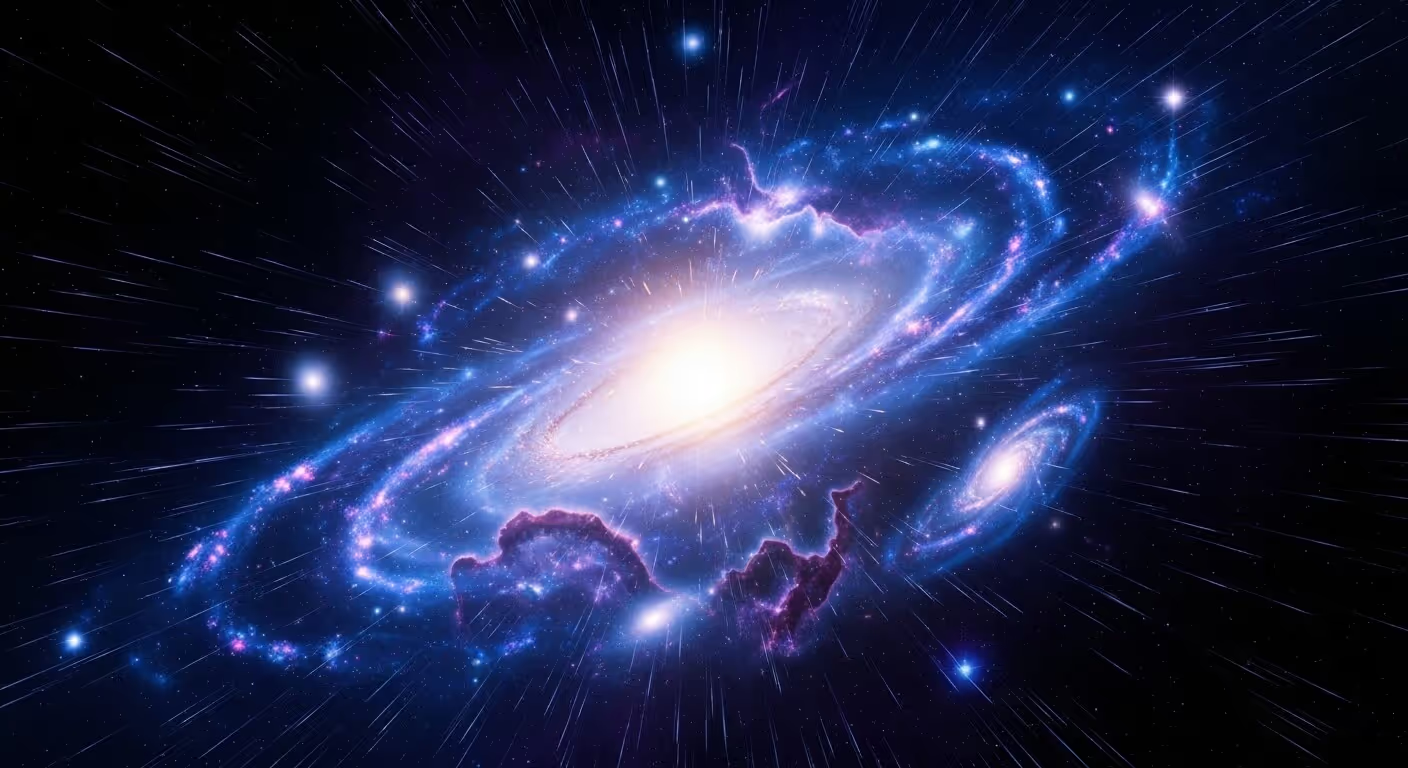
The universe is the ultimate storyteller, and its narrative spans an incomprehensible cosmic timeline, from its fiery birth to its eventual, enigmatic demise.
Join us on an epic journey through time, exploring the key epochs that have shaped our cosmos and pondering the ultimate fate that awaits everything we know.
Our story begins not with an explosion in space, but an expansion of space itself. The Big Bang theory describes the universe's origin as an incredibly hot, dense singularity.
In the first fractions of a second, the universe underwent an astonishing period of inflation, expanding faster than the speed of light, smoothing out irregularities and planting the seeds for future galaxies.
After recombination, the universe entered a period known as the Cosmic Dark Ages. There were no stars, no galaxies, just a vast expanse of neutral hydrogen and helium gas, bathed in the faint glow of the CMB.
Gravity, however, was silently at work. Over hundreds of millions of years, tiny density fluctuations in the gas, amplified by the unseen influence of dark matter, began to pull matter together.
Eventually, these clumps became dense enough to ignite. The first stars, known as Population III stars, were colossal, short-lived, and incredibly luminous.
Their intense ultraviolet radiation ionized the surrounding gas, ending the Dark Ages and ushering in the era of reionization.
These first stars also began forging heavier elements in their cores, scattering them into space through supernova explosions – the cosmic building blocks for future stars, planets, and life.
As gravity continued its relentless work, the first stars coalesced into the first galaxies. These early galaxies were often smaller and more irregular than the grand spirals and ellipticals we see today.
Through countless mergers and interactions, they grew, forming the intricate cosmic web of galaxies, clusters, and superclusters that defines the large-scale structure of the universe.
Our own Milky Way galaxy formed billions of years ago, and within it, our Sun ignited about 4.6 billion years ago, surrounded by a swirling disc of gas and dust that eventually coalesced into the planets of our solar system.
For billions of years, galaxies have continued to evolve, giving birth to new stars, witnessing the spectacular deaths of old ones, and occasionally colliding in cosmic ballets that reshape their structures.
Our journey through time doesn't end in the present. Based on current cosmological models, primarily driven by the mysterious influence of dark energy, we can project the universe's likely ultimate fate.
This cosmic journey through time, from the Big Bang to the Dark Era, is a testament to the dynamic and evolving nature of our universe.
It reminds us of our fleeting existence within an unimaginably grand tapestry, a story that is still unfolding, leaving us with both profound awe and an insatiable desire to understand the universe's ultimate beginning and its inevitable end.

