Sorry... Cosmix was built as a web design demo site.
You can view the Home page, Blog Page, and/or read blog posts.
The About, Contact, and Learn More links are just filler content.

Sorry... Cosmix was built as a web design demo site.
You can view the Home page, Blog Page, and/or read blog posts.
The About, Contact, and Learn More links are just filler content.



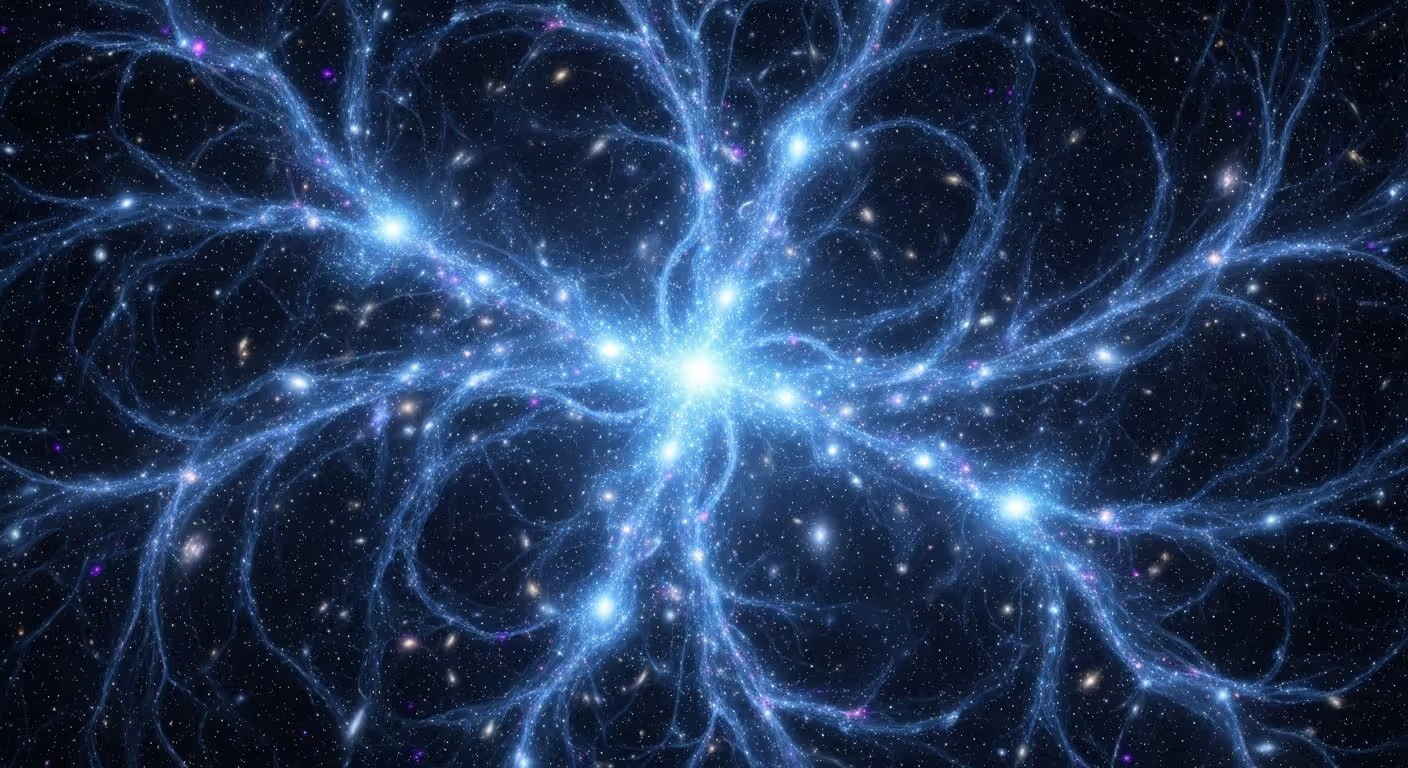
Look up at the night sky and you see a relatively uniform sprinkling of stars. But zoom out, past our local solar system and the Milky Way, to the grandest scales of the universe, and an astonishing picture emerges.
The cosmos isn't a random soup of galaxies; it's a colossal, three-dimensional tapestry, an intricate network of filaments and voids known as the Cosmic Web.
This web is the universe's large-scale structure, and it holds the key to understanding how galaxies formed and how the universe evolved.
The Cosmic Web is made up of three main components:
Think of it like a sponge: the filaments and clusters are the dense, porous parts, while the voids are the holes.
The Cosmic Web's existence is a direct consequence of the interplay between dark matter and gravity. In the very early universe, after the Big Bang, matter was distributed almost perfectly uniformly.
However, tiny, quantum fluctuations in density meant that some regions were slightly more massive than others. Over billions of years, gravity began to pull matter into these slightly denser regions.
Because dark matter makes up about 85% of the universe's total matter, it was the primary architect of this structure. Dark matter, which only interacts through gravity, formed the invisible scaffolds of the cosmic web first.
Normal matter—the stuff of stars, planets, and us—was then pulled along by dark matter's gravitational influence, accumulating into the filaments, nodes, and clusters we observe today.
The Cosmic Web is not a static structure. Galaxies within the filaments are not just sitting there; they are actively being drawn along these cosmic rivers towards the great clusters at the nodes.
This gravitational flow, sometimes called "cosmic flows," is a powerful force that drives galaxy evolution. As galaxies fall into these denser regions, they undergo dramatic transformations:
We are not at the center of the universe, but we do have a specific address within the Cosmic Web. Our Milky Way is part of the Local Group of galaxies, which itself is part of the Virgo Supercluster.
We are currently on the outskirts of the immense Laniakea Supercluster, which is flowing towards a gravitational anomaly known as the Great Attractor.
This constant, invisible flow reminds us that the universe is a dynamic, interconnected system on all scales.The Cosmic Web provides cosmologists with a powerful tool to test our understanding of the universe.
Its structure and evolution are a direct result of the laws of physics and the ingredients of the universe, including the enigmatic dark matter and dark energy.
By mapping the web, we can trace the universe's history from its initial seeds to the magnificent structure we see today, revealing how the tapestry of galaxies was woven together over billions of years.

