Sorry... Cosmix was built as a web design demo site.
You can view the Home page, Blog Page, and/or read blog posts.
The About, Contact, and Learn More links are just filler content.

Sorry... Cosmix was built as a web design demo site.
You can view the Home page, Blog Page, and/or read blog posts.
The About, Contact, and Learn More links are just filler content.



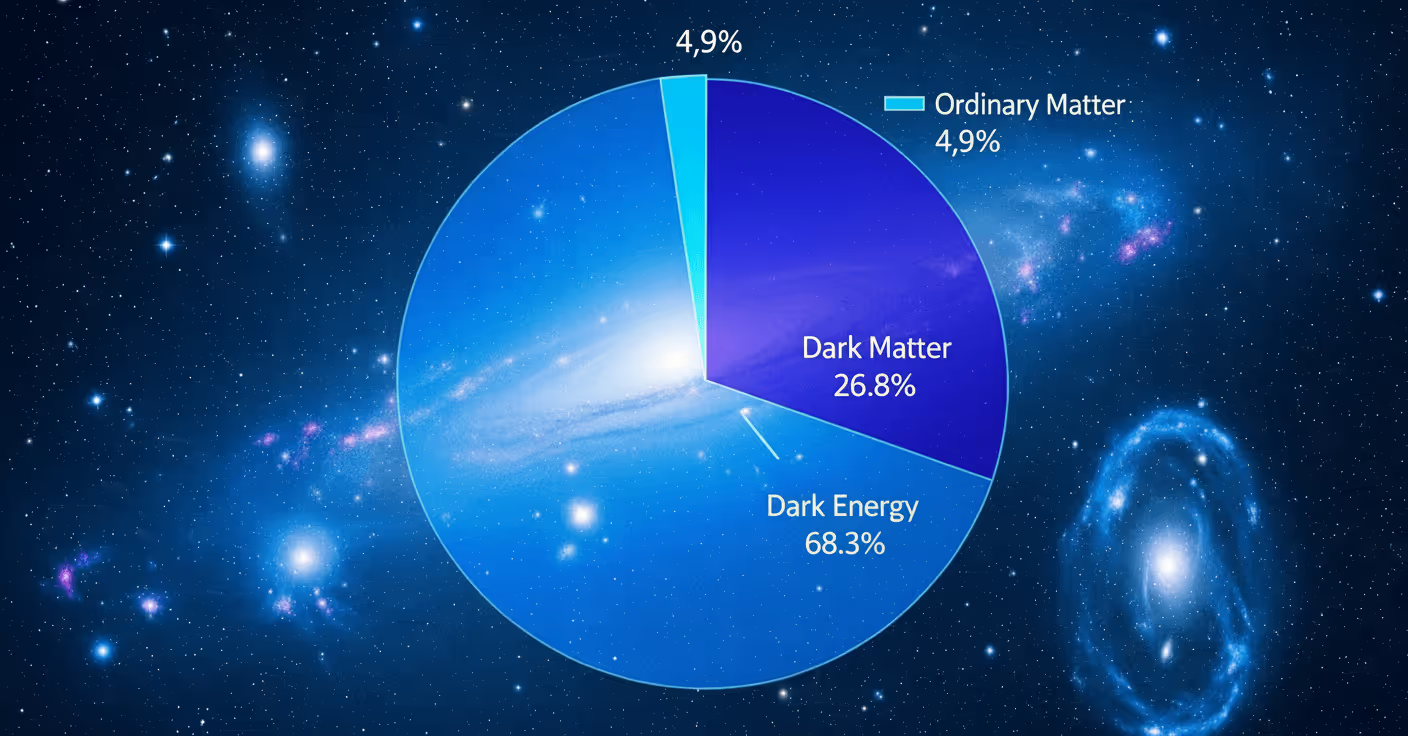
Imagine gazing up at the night sky, admiring the countless stars and galaxies, and then realizing that all the visible matter – everything we can see, touch, and measure – makes up only about 5% of the universe.
The vast majority, a staggering 95%, is composed of two enigmatic entities: dark matter and dark energy.
These invisible forces are the universe's ultimate puppet masters, shaping its structure and dictating its destiny, yet remaining frustratingly elusive.
The concept of dark matter first emerged in the 1930s when astronomer Fritz Zwicky observed that galaxies in the Coma Cluster were moving too fast to be held together by the gravitational pull of their visible matter alone.
There had to be an unseen, additional mass providing extra gravity. Decades later, Vera Rubin's meticulous studies of galaxy rotation curves in the 1970s provided irrefutable evidence: the outer regions of galaxies were rotating just as fast as the inner regions, implying a massive, invisible halo extending far beyond the visible stars.
So, what is dark matter? We know what it isn't:
Instead, dark matter is thought to be made of exotic, non-baryonic particles that interact with normal matter only through gravity. Leading candidates include:
Scientists are actively searching for dark matter particles in underground laboratories, hoping to detect their rare interactions with ordinary matter.
The Large Hadron Collider (LHC) also plays a role, attempting to create these particles in high-energy collisions. The discovery of dark matter would not only solve a major cosmic puzzle but also usher in a new era of particle physics, revealing a whole new sector of the universe.
While dark matter acts like the invisible glue holding galaxies together, dark energy is the invisible force pushing the universe apart.
Its existence was a complete surprise. In the late 1990s, observations of distant supernovae, used as "standard candles" to measure cosmic distances, revealed that the universe's expansion isn't slowing down due to gravity, as expected.
Instead, it's accelerating.This acceleration required a new, repulsive force permeating all of space. We still don't know what dark energy is, but the leading theories include:
Dark energy is far more mysterious than dark matter because we have even fewer clues about its nature. It doesn't appear to clump like dark matter but is distributed evenly throughout the cosmos.
It's the dominant component of the universe, dictating its ultimate fate – likely a future of ever-accelerating expansion, leading to a cold, desolate "Big Chill."
Dark matter and dark energy represent the biggest challenges and most exciting opportunities in modern cosmology. They are the keys to understanding the universe's past, present, and future.
Telescopes like the Hubble Space Telescope and its successor, the James Webb Space Telescope, map the distribution of galaxies, providing clues to dark matter's influence.
Upcoming missions like the Nancy Grace Roman Space Telescope will further investigate dark energy by precisely measuring the expansion rate of the universe.
Unveiling the mysteries of dark matter and dark energy is a monumental task, but one that promises to rewrite our understanding of the cosmos and our place within it. It's a journey into the deepest unknowns, where the invisible forces of the universe hold the most profound secrets.

